Cotton statistics revealed: Spreadshirt’s Trend Report No 58 / December 2014
Leipzig, 16 December 2014. Since the second half of November, the T-shirt printers at Spreadshirt have been blazing with industrious passion to meet the demands of our Christmas production. The postman has his work cut out helping Santa deliver all those parcels, and we’re using the opportunity to lean back, sip our freshly brewed coffee and cop a look at the cotton statistics of the past few months.
Heavy cotton
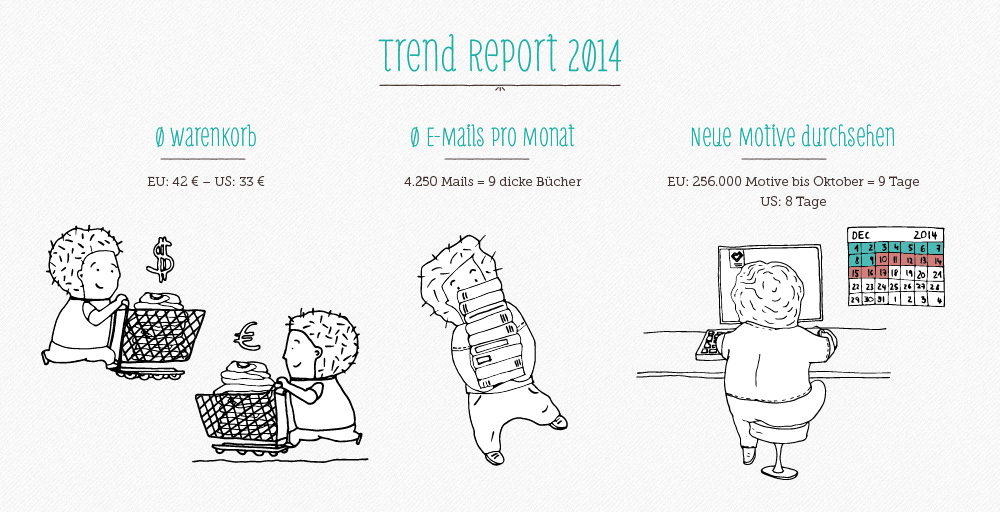
From January to October, there were over a million orders executed by Spreadshirt thanks the sedulous activity and care applied by our staff. Having a closer look at the individual products, it’s clear to see that the T-shirt is still a firm favourite among our customers. If you’d add up the weight of all the T-shirt orders individually, you’d come up with a total weight of about 150,000 gallons of water. And that’s quite massive. Talking about weight – the European shopping basket was substantially heavier than the North American one. While the average European basket of 42 Euro has an approximate value of six movie tickets, the average North American basket of 33 Euro only equals about four and a half movies. The most expensive product this year was ordered by a European customer at a price of 276 Euro. Her Women’s T-shirt (in black) could have bought our esteemed Swiss customer about 10kg of Swiss Appenzeller cheese, or, alternatively, a 2-night stay including breakfast at Hotel Appenzell in the mountain resort with the same name. We are sure, however, that the Swiss lady did the right thing opting to spend it on a beautifully personalised tee seeing that it’s going to keep her company for a very long time. Our most expensive custom American product was about 100 Euro cheaper, the amount of which would have been merely enough to visit the Empire State Building about eight times.
Shifting the perspective
Our tower of white men’s tees on stock is 49 meters high, all waiting to be adorned with great designs and slogans. There’s a total of 121,000 meters of rolled up foil used for flex and flock printing over the year, which would – if rolled out – cover the whole 121km (75 miles) distance between the German cities of Leipzig and Dresden. The same 121km length of cables has been strung up in Canberra, Australia, to replicate the world-record display of Christmas lights on 27 November this year. What’s more, the ink needed for our annual digital direct prints corresponds to 32 bathtubs. And if we would bind books from all the emails that have been sent to us since Spreadshirt was founded, you’d need a whole library to accommodate these. We receive some 4,250 emails on average every month, and this is about 3.5 times the volume of the Lord of the whole Rings trilogy alone.
Designs of the time
A single employee would need about nine days (and nights) to click through all of the 256,000 designs submitted to us between January and October 2014. And this only accounts for what’s been submitted in Europe: The sorrowful guy would need another 8 days of restless clicking to see what’s been uploaded in North America as well. Of course we value our staff’s sleeping habits, so we’ve got a whole Design Service team and special software in place to take care of this immense glut of design submissions.
We’d like to conclude this little round-up with a few impressive stats from our T-Shirt Designer. European customers have about 2.8 billion options to personalise a product with a single design, which in turn would mean that about 743 million Europeans could choose as many as four different product and design combinations while still receiving a completely unique product. And this equation disregards that you can put several designs and also individual text to create custom made gear. We can conclude this report with one safe assumption for 2015: the creative potential for the individual knows no limits!